Oaxaca's disappearing water holds a lesson for the Pacific Rim
A drought in Mexico's southern states reveals a vulnerability that extends far beyond its borders, echoing concerns for food security and livelihood across the Pacific.
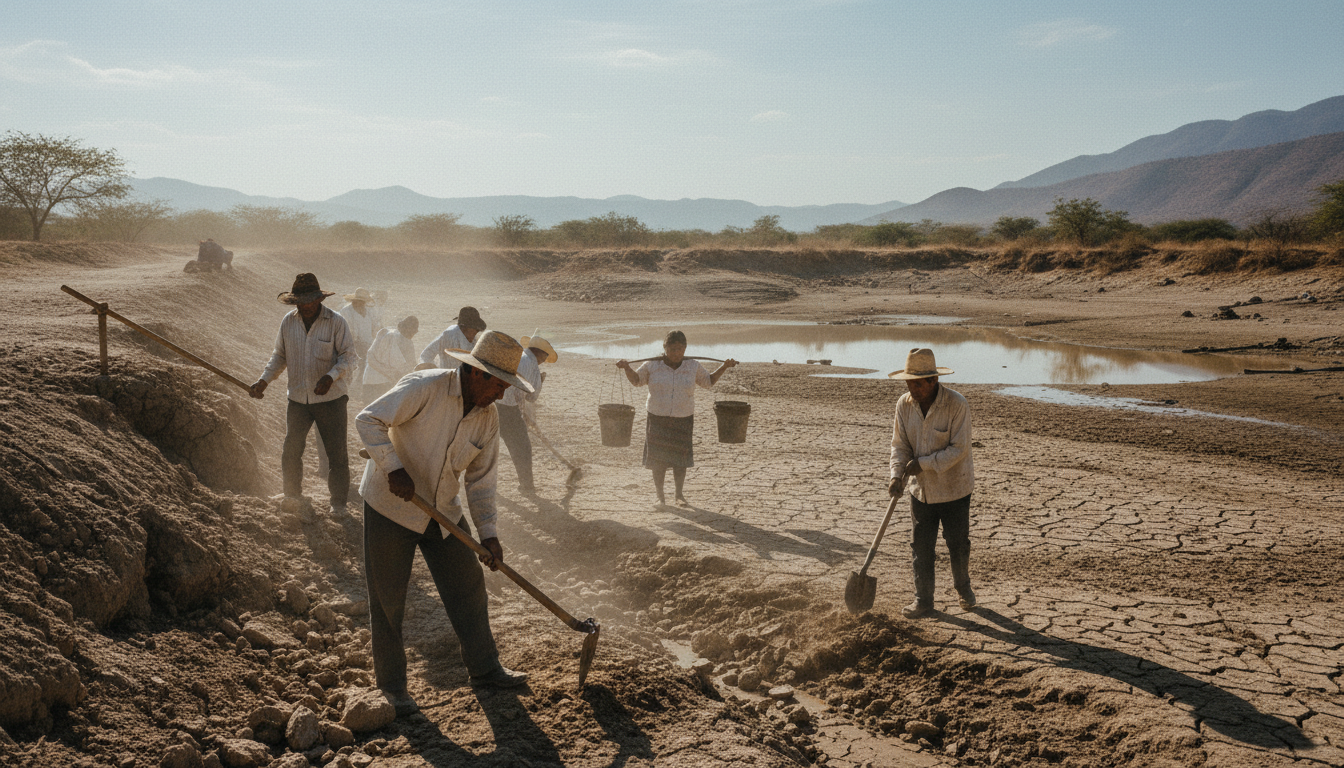
The earth in Oaxaca and Guerrero, two southern states of Mexico, is parched. Farmers in these regions report a drought so severe it has, in some cases, wiped out all agricultural production. Two associations of women farmers—one in Oaxaca, one in Guerrero—issued a joint statement last week, describing corn crop losses as high as 100%. This is not merely an agricultural crisis, but a direct attack on the economic well-being of those who rely on the land. The National Water Commission’s 'drought monitor' report supports these claims, categorizing large swathes of these states as 'abnormally dry' or experiencing 'moderate drought'.
This landscape, often depicted in travel brochures as a sun-drenched idyll, reveals a starker reality. The Pacific coast of Mexico is no stranger to meteorological extremes. Just this year, Hurricane Erick slammed the coast as a powerful Category 3 storm in February, later weakening to a tropical storm, leaving behind a trail of damage by June. Tropical Storm Boris formed off the southern Pacific coast in June, bringing its own threat of flooding. These intense, cyclical events—from deluge to desertification—underscore an environment in constant flux, demanding adaptation from its inhabitants. Yet, what happens when the shift is too profound, too prolonged?
The women farmers' associations are calling for authorities to declare a climate emergency and establish programs to guarantee food sovereignty. This plea for official recognition and intervention hints at a deeper, systemic fragility. While the immediate crisis is local, the underlying conditions resonate across the Pacific Rim. Thailand, for instance, with its vast agricultural sector and coastal communities, faces similar pressures from shifting weather patterns and the intensifying push-pull of extreme events. The question for any place, then, is not if, but when, its foundational resources will be stressed to breaking point.
Indeed, some might argue that such localized events in Mexico, while tragic, are isolated incidents, part of a natural climatic variability. They might point to the region's history of hurricanes and El Niño cycles, suggesting that these communities have always, to some degree, adapted. However, the scale and reported severity of crop loss, particularly the 100% figures from organized farmer groups, suggest a qualitative shift. This is not simply a bad season; it is, for many, an existential threat. The repeated and extreme oscillation between powerful storms and profound drought presents a scenario where the customary resilience of communities is systematically eroded. The challenge is not merely to rebuild, but to fundamentally reconsider the relationship between land, water, and human sustenance in an unpredictable environment. The parched fields of Oaxaca serve as a profound, if unwelcome, harbinger for many agricultural regions across the Pacific.
Sources
Newsletter
Pacific Daily
A curated briefing from Thailand, Asia-Pacific and the world.