Deep-Sea Discoveries Challenge Indian Ocean Logistics
New species identification from the NUS-OceanX expedition highlights operational complexities for future marine exploration and resource assessment in the Asia-Pacific.
SINGAPORE
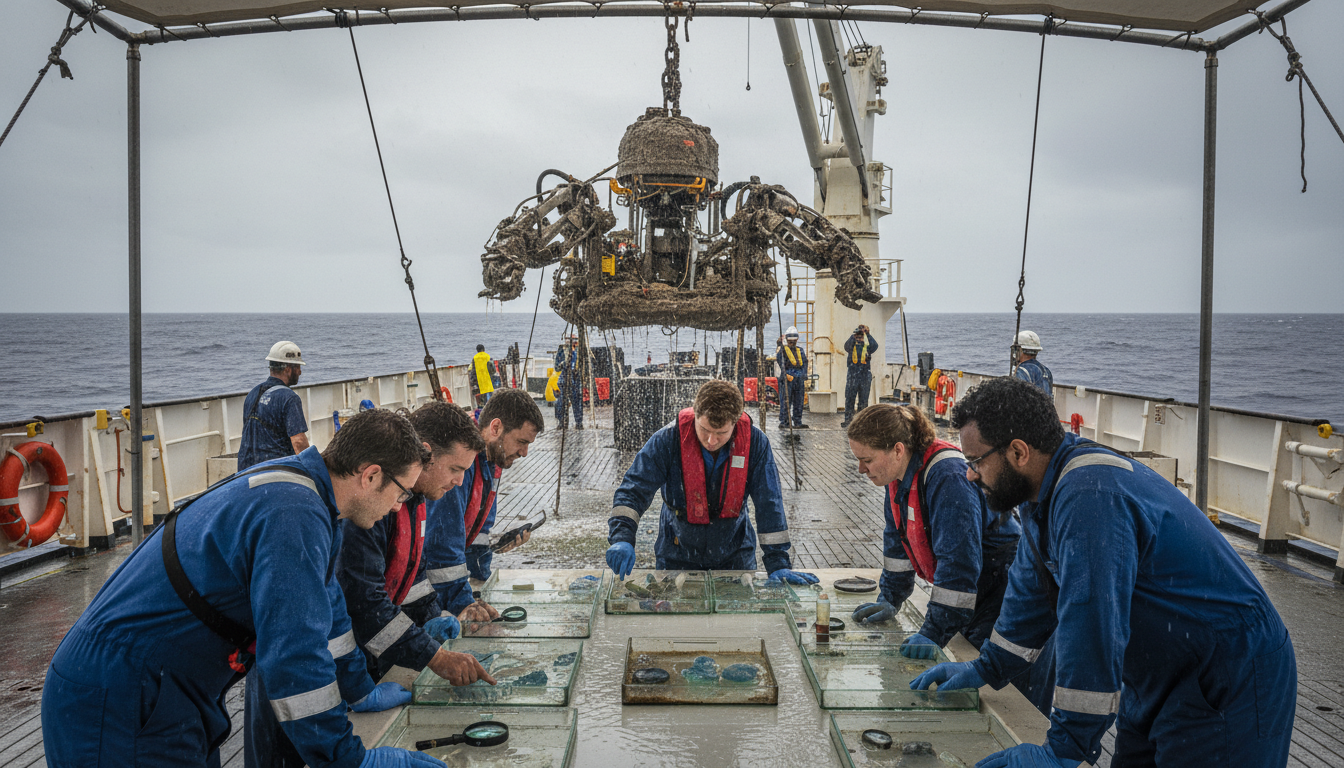
The recent NUS-OceanX expedition, which mapped over 6,000 sq km of the Indian Ocean's deep sea and returned with more than 2,000 specimens, including at least 20 potentially new species, represents a significant gain in scientific knowledge. The operation's success in collecting such a volume of material from previously unmapped areas underscores the scale of biological diversity in the region. This activity, reported by CNA Lifestyle on 2026-09-17, follows earlier observations of rare deep-sea life in natural habitats and initial expedition planning in October 2025.
The logistical demands of this expedition — mapping thousands of square kilometres and retrieving thousands of specimens — suggest a substantial operational footprint. Each specimen requires careful handling, preservation, and classification, processes that scale non-linearly with volume. Dr. Allison Miller, for instance, was observed showing sea cucumbers to CNA’s Caitlin Ng, an indication of the immediate post-retrieval procedures. The implied infrastructure for such an undertaking includes specialized vessels, on-board laboratories, and robust specimen transport and storage systems capable of maintaining integrity from collection point to research facility.
The immediate implication for the Asia-Pacific, particularly for nations with Indian Ocean coastlines like Thailand, is an increased awareness of marine biodiversity in deeper waters. While the expedition focused on scientific discovery, the operational capacity demonstrated for deep-sea exploration could also translate to other activities. Such capabilities are often adaptable for resource assessment or, conversely, for monitoring environmental impacts at depth. The significant area mapped and the volume of specimens recovered suggest a refined process for conducting such operations, which might set a new standard for future deep-sea ventures.
However, a direct economic impact on coastal states like Thailand is not immediately clear. The Indian Ocean is an area of increasing geopolitical interest, marked by great power rivalry, as noted by the Lowy Institute on 2026-07-19. This context suggests that any significant deep-sea operational capacity developed by entities like NUS-OceanX could become relevant beyond pure scientific research. The counterargument posits that this expedition is primarily academic, its outputs confined to species classification and ecological understanding. This perspective focuses solely on the biological findings, such as the potential discovery of new species, and less on the underlying operational mechanisms that enabled them.
The limitation of this assessment lies in the available data; the financial cost of this expedition, the specific technological innovations employed for specimen retrieval and preservation at scale, and the human resources deployed are not detailed. Without these specifics, a full evaluation of the operational model's replicability or scalability for broader regional application remains speculative. Nevertheless, the successful execution of an expedition yielding such extensive findings indicates a functional, high-capacity deep-sea operation. The outcome for future deep-sea engagement across the Indian Ocean now depends on whether the operational blueprints are shared, adapted, or further enhanced for objectives beyond pure research.
Sources
Newsletter
Pacific Daily
A curated briefing from Thailand, Asia-Pacific and the world.