Beyond the Cloud: What a Tech Boost in China Means for Bangkok's Streets
The quiet shift from physical to digital infrastructure could reshape urban rhythms in the Asia-Pacific.
BANGKOK
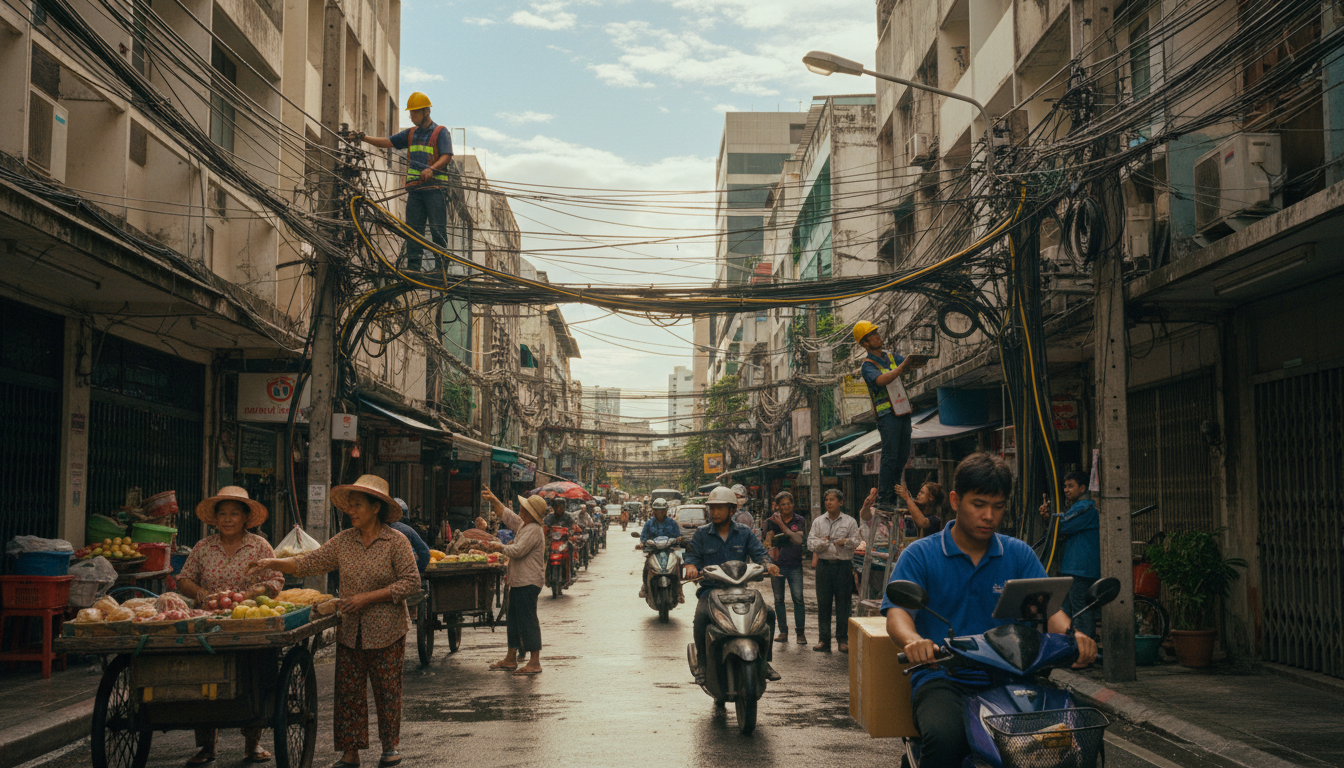
The narrow alleyways of Bangkok, perpetually shifting with the rhythm of vendors and passersby, might seem a world apart from the strategic maneuvers of a Chinese artificial intelligence firm. Yet, the recent financial injection into Z.ai, resulting in a 25 percent hike in its year-end annual recurring revenue outlook to US$3 billion, speaks to a foundational change that will inevitably echo in these very streets.
Z.ai, a Chinese artificial intelligence developer, disclosed during an investor call that a US$5 billion cash infusion had helped clear its computing capacity bottlenecks for the time being. This move allowed the firm to raise its projected annual recurring revenue from an earlier estimate of about US$2.4 billion. While these figures represent high-level corporate strategy and the clearing of technical hurdles, their ripple effects extend to the cultural and commercial spaces of cities like Bangkok.
Consider the habit that changes first: the invisible infrastructure. The firm's capacity constraint, now described as no longer a 'primary constraint,' points to a moment where the purely digital realm gains new latitude. When computing power becomes less of a limiting factor for an AI developer, it means a wider range of digital services can be imagined, built, and scaled. Who notices this first? Perhaps not the street vendor directly, but the digital service providers who cater to them, or the urban planners contemplating smart city initiatives dependent on robust AI capabilities.
In Bangkok, the ongoing discussions around digital transformation, from cashless payments in markets to AI-driven traffic management systems, are underpinned by such technological advancements. A surge in AI capacity in a regional player like Z.ai suggests an increased availability of the foundational tools needed to power these transformations. This might lead to more sophisticated digital applications becoming commonplace, altering how services are delivered and consumed, and ultimately reshaping daily interactions.
However, attributing direct cultural shifts to a single corporate financial event carries limitations. The direct impact on the day-to-day life of, say, a family in Chiang Mai remains an inference. The adoption of new technologies is often slowed by local infrastructure, regulatory frameworks, and cultural preferences, which may not align perfectly with the pace of technological development. The financial health of an AI developer does not, by itself, guarantee widespread integration or cultural acceptance of its potential products.
Still, the immediate implication for the Asia-Pacific region is that the digital tide continues to rise. The physical environment, vibrant and tactile, increasingly overlays with an equally complex digital layer. When a significant player like Z.ai overcomes a 'primary constraint' in its operations, it is a signal that the abstract force of artificial intelligence gains new momentum, inevitably redrawing the unseen lines that govern how cities function and how their inhabitants navigate them. The scent of street food and the hum of an AI-driven delivery drone may one day simply be part of the same urban scene.
Sources
Newsletter
Pacific Daily
A curated briefing from Thailand, Asia-Pacific and the world.